Research Overview
PELVIC INFLAMMATORY DISEASE
Neisseria gonorrhoeae can infect the Fallopian tubes. A large inflammatory response to molecules released by the bacteria results in pelvic inflammatory disease (PID). In particular, a gonococcal outer-membrane component, lipooligosaccharide, and a cell wall component, peptidoglycan, result in responses from the human cells that kill ciliated cells of the Fallopian tube. The tube can become scarred, can close up on itself, and can even become attached to other nearby parts of the patient’s anatomy, resulting in tubal factor infertility, chronic pelvic pain, and increased risk of ectopic pregnancy. We use a human organ culture model of infection to identify bacterial mechanisms and host responses that result in the tissue damage.
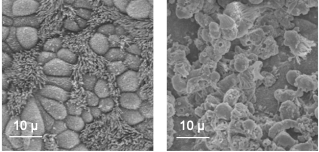
Scanning electron micrographs show A) normal human Fallopian tube tissue, and B) Fallopian tube tissue that was infected with gonococci (GC), strain MS11. During infection the ciliated cells slough from the epithelium and can be seen as dead cells and cell debris lying on the tissue.
INFLAMMATORY PEPTIDOGLYCAN FRAGMENTS
All Neisseria gonorrhoeae isolates examined to date are defective in the recycling of peptidoglycan fragments. As the bacteria grow and divide, they have to degrade strands of peptidoglycan and cut the peptide crosslinks that hold the strands in place. This process makes space for additional strands to be inserted into the cell wall so it will grow and form the characteristic coccal shape. When the peptidoglycan strands are degraded, peptidoglycan fragments are created in the periplasmic space, and those fragments can be released into the infection milieu, or they can be taken up into the bacterial cytoplasm for recycling. In gonococci, the permease protein AmpG, which functions in uptake of peptidoglycan fragments for recycling, has three amino acid changes in the C-terminal membrane-spanning region of the protein compared to the closest related Neisseria species. These changes cause gonococci to release 3-4 times as much peptidoglycan as their more-commensal relatives. In addition, gonococci have a peptidoglycan fragment-modifying enzyme localized to the periplasm, LdcA, that is found in the cytoplasm of most other bacteria. The modification of the peptide in the periplasm, shortening it to three amino acids, means that most of the peptidoglycan fragments released from the bacteria will be the tripeptide monomer, a molecule that strongly stimulates an inflammatory response due to its recognition by the human receptor NOD1. We have evidence that another peptidoglycan modifying enzyme, NlpC, is periplasmically localized and modifies peptides to make the dipeptide monomer, a molecule predicted to stimulate an inflammatory response through the receptor NOD2. Gonococci have been shown to elicit a NOD2-mediated inflammatory response in infection models. Furthermore, N. gonorrhoeae is known to release the tetrapeptide monomer of peptidoglycan, known as tracheal cytotoxin or TCT, that acts to kill ciliated cells in the hamster tracheal model of Bordetella pertussis infection. The role of TCT in gonococcal infection is currently unknown.
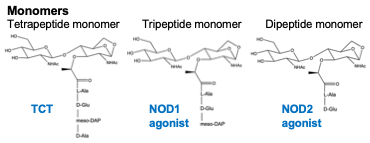
The most abundant peptidoglycan fragments released by N. gonorrhoeae are the monomeric fragments. The tripeptide monomer is sufficient to kill ciliated cells in the human Fallopian tube infection model.
BACTERIAL VAGINOSIS
Bacteria of the genus Gardnerella act to create a dysbiosis in the vagina. The normally abundant lactobacilli are displaced, and anaerobic and facultative bacterial species flourish. The disease is called bacterial vaginosis (BV), and it results in pain, itching, malodor, and dysuria. Pregnant women with BV are predisposed to premature delivery, chorioamnionitis, and postpartum endometritis. Premature birth is the leading cause of infant death. Patients with BV are also much more likely to acquire sexually transmitted infections including gonorrhea, chlamydia, HSV-2, and HIV. We are working to determine the virulence factors Gardnerella species employ during BV. The bacteria adhere to vaginal and cervical epithelial cells, lyse epithelial cells and neutrophils using the toxin vaginolysin, form a biofilm that multiple BV-associated bacteria grow within, and produce enzymes that break down mucus and other host molecules. To study the pathogenic processes, we developed methods for making genetic mutations and complements in various Gardnerella species. We are studying mutants lacking adhesins such as pili and fibronectin-binding proteins, mutants lacking vaginolysin, and mutants lacking glycosidases including sialidase and a putative fucosidase. Patients with BV are more likely to acquire gonorrhea, and patients with gonorrhea are more likely to develop BV. So, we are determining how Gardnerella and gonococci aid each other in growth, infection, and immune evasion.